
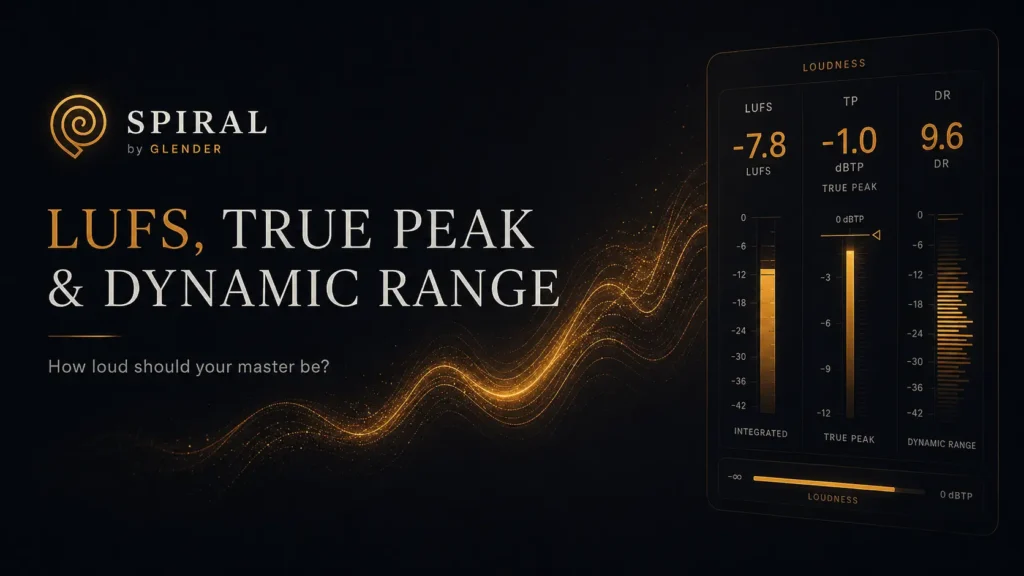
LUFS, True Peak and Dynamic Range: The Quality Advocate’s Guide
Why pushing for loudness can make your master sound smaller — and how to balance power with dynamics using LUFS, true peak, and smart metering.
LUFS, True Peak and Dynamic Range: The Quality Advocate’s Guide
The Loudness Paradox
Louder masters often sound “smaller.” It’s the ultimate paradox of modern audio: as you push the limiter to shave off decibels, the distance between your quietest and loudest moments shrinks. Transients lose their snap, the stereo image flattens, and the track becomes a tiring wall of sound.
A master can reach impressive loudness and still feel weak, losing the soul and movement that gave the original mix its life. In SPIRAL, we don’t chase universal numbers. We balance competitive volume with the absolute preservation of musical character.
The Myth of the Target Number
Assuming every track must hit a specific LUFS value is a strategic mistake. An atmospheric House track and a dense Afro Tech record have different needs. The real question is: “How much loudness can this specific track support before its musical impact decreases?”
If the kick loses its attack or the stereo image collapses, back off. Higher is not always more professional; lower is not always weak. Let the music decide the limit.
Why Digital Normalization Changed the Rules
Digital platforms now use loudness normalization to provide a consistent experience. If you push a master too hard, the platform will simply turn it down. Excessive limiting leaves you with a track that is no louder than the rest, but significantly flatter and more fatiguing.
When playback levels are normalized, the quality of the master—not the raw volume—becomes the focus. Tonal balance and micro-dynamics are the new frontiers of “power.” Quality always beats quantity.
The Technical Pillars: Perceived vs. Digital
To advocate for quality, you must understand your meters:
- Understanding LUFS: Unlike peak meters, LUFS (Loudness Units relative to Full Scale) mimics human hearing by measuring energy behavior over time. Integrated LUFS measures the average across the track, while Short-term (3s windows) helps check if your chorus has enough “lift.”
- The Safety Margin (True Peak): Standard meters miss inter-sample peaks during reconstruction. True-peak measurement ensures your master stays clean (usually at -1 dBTP) across all devices and encoders, preventing unwanted distortion.
- Headroom Management: Bass consumes the most energy. Before pushing for volume, clean your low end. Removing subsonic rumble creates “free” headroom, allowing for higher perceived loudness without crushing the mix.
Finding the Right Level
Start with a balanced mix. In SPIRAL, correct tonal issues first—small EQ moves often create more space than aggressive limiting. Increase loudness gradually and always compare at equal perceived volumes.
The best master isn’t the loudest; it’s the one that remains powerful after the volume has been matched.
Enter SPIRAL.