
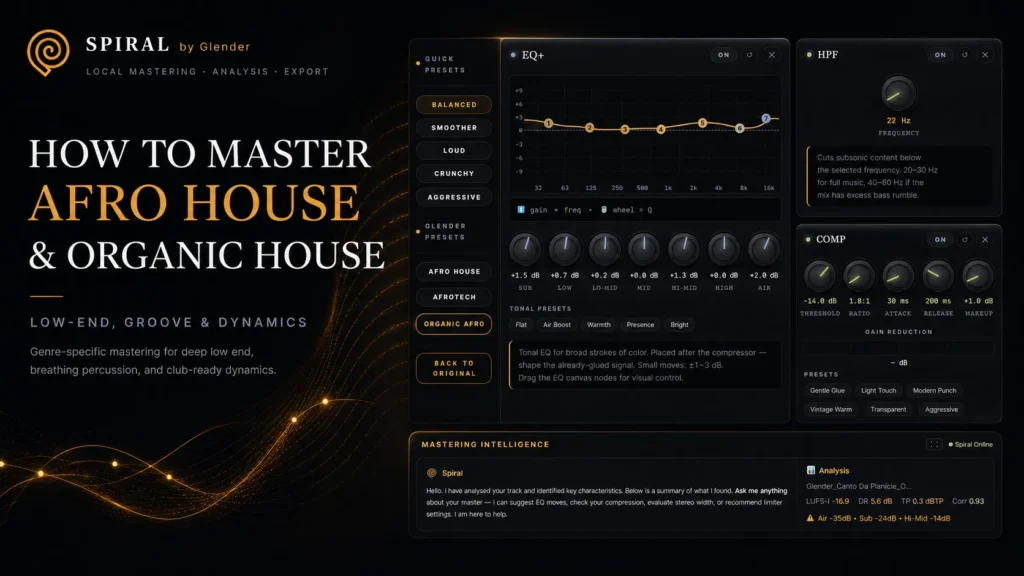
How to Master Afro House and Organic House: Low-End, Groove and Dynamics
Afro House and Organic House demand a unique mastering approach: controlled sub-bass, organic dynamics, and groove preservation.
How to Master Afro House & Organic House: Low-End, Groove & Dynamics
Afro House and Organic House present a unique mastering challenge. These genres thrive on elements that aggressive mastering destroys: deep, controlled sub-bass; organic, breathing percussion; wide dynamic range between breakdowns and drops. A master that works for Mainstage EDM — crushed, bright, relentlessly loud — will ruin an Afro House track. This guide covers the genre-specific EQ, compression, and loudness decisions that preserve the soul of Afro House while making it club-ready.
The Afro House Low-End: Control, Do Not Crush
Afro House carries heavy sub-bass between 40–80Hz, layered with organic kick drums and percussive basslines. The low end must feel powerful but controlled — loose sub-bass eats headroom and forces the limiter to work too hard.
- HPF at 25–30Hz. Subsonic energy below 25Hz is inaudible but consumes massive headroom. A 30Hz filter tightens the low end immediately without removing audible bass.
- Check 50–60Hz. The power zone for Afro House kicks. If it is booming, use a narrow EQ cut (-1 to -2dB, Q=4–6) rather than broadband compression. Surgical, not brutal.
- Control 100–150Hz. Adds warmth but can become muddy. A gentle wide cut (-0.5 to -1dB, Q=1–2) cleans the low-mids without thinning the track.
Preserving Organic Percussion Dynamics
Afro House relies on percussive movement — congas, shakers, djembe, organic hi-hats that breathe and shift. Heavy compression flattens this movement and makes the groove feel mechanical. Your percussion should sound like human hands, not a drum machine.
- Slow attack (50–100ms) on the mastering compressor. Let transient percussion through.
- 1–2dB of gain reduction maximum. Just enough to glue the rhythm section.
- If the compressor visibly moves on every kick: Release too fast or threshold too low.
Loudness Targets for Afro House
| Context | Target LUFS | True Peak |
|---|---|---|
| Streaming (Spotify, Apple Music) | -12 to -14 LUFS | -1 dBTP |
| Club / DJ Sets | -9 to -11 LUFS | -0.3 dBTP |
| SoundCloud / Self-Release | -10 to -12 LUFS | -1 dBTP |
Mastering Afro House in SPIRAL
SPIRAL by GLENDER was built by an Afro House producer — the genre is in its DNA. Presets like “Organic Afro” and “Afro Tech” give you starting points calibrated for the genre’s low-end weight, dynamic range, and organic texture. From there, you control the full chain: HPF for subsonic cleanup, corrective EQ for surgical fixes, saturation for analog warmth, compression for gentle glue, tonal EQ for color, M/S for width and focus, and brickwall limiting with real-time LUFS and true peak monitoring.