
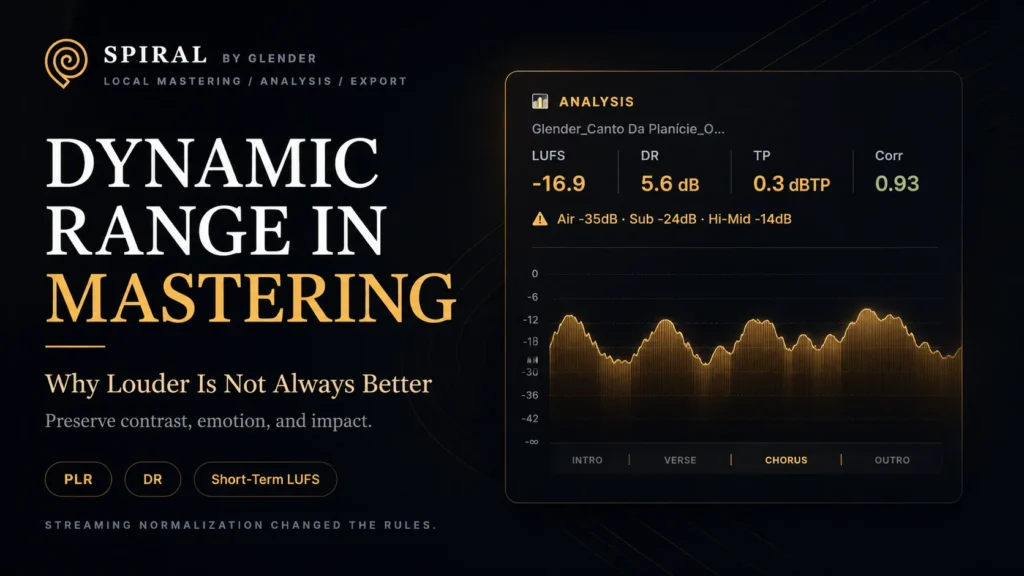
Dynamic Range in Mastering: Why Louder Is Not Always Better
The loudness war is over. Learn why preserving dynamic range creates more powerful, emotionally engaging masters.
Dynamic Range in Mastering: Why Louder Is Not Always Better
The loudness war lasted 25 years. From the early 1990s to the mid-2010s, mastering engineers competed to make records increasingly louder — because louder records stood out on radio, in clubs, and on CD changers. The result? Records with 2-3 dB of dynamic range. Flat, fatiguing, lifeless.
Then streaming normalization changed the rules. When Spotify turns every track to -14 LUFS, the crushed -5 LUFS master does not sound louder than the well-balanced -14 LUFS master next to it. It sounds smaller, flatter, and more fatiguing. The loudness war is over — and dynamic range is what separates a powerful, emotionally engaging master from a forgettable one.
What Is Dynamic Range?
Dynamic range is the difference between the quietest and loudest moments in your track — measured in decibels. A track with high dynamic range breathes. Verses feel intimate. Drops hit hard. The contrast between quiet and loud creates emotional impact. A track with low dynamic range is uniformly loud — and uniformly boring. Nothing stands out because everything is at the same level.
How to Measure Dynamic Range
- PLR (Peak-to-Loudness Ratio): True peak minus integrated LUFS. A PLR of 12–14 dB = healthy dynamics. Below 8 dB = over-compressed.
- DR Meter (Dynamic Range Meter): Traditional DR8–DR14 scale. DR12+ = excellent dynamics (jazz, classical). DR8–10 = typical for electronic music. DR5–7 = loudness war victim.
- Short-term LUFS variation: If your short-term LUFS stays within 2 LUFS of your integrated across the whole track, you have likely over-compressed. A dynamic track has 4–8 LUFS of variation between sections.
Dynamic Range by Genre
| Genre | Typical DR | Typical LUFS |
|---|---|---|
| Classical / Jazz | DR12–18 | -18 to -23 LUFS |
| Afro House / Organic House | DR8–12 | -10 to -14 LUFS |
| Deep House / Melodic Techno | DR7–10 | -9 to -13 LUFS |
| Techno / Tech House | DR6–9 | -8 to -11 LUFS |
| Pop / EDM / Mainstage | DR5–8 | -7 to -10 LUFS |
| Hip-Hop / Trap | DR5–8 | -7 to -10 LUFS |
How to Preserve Dynamics While Mastering
- Use less limiting. If you need more than 3–4 dB of gain reduction, the problem is earlier in the chain — not the limiter. Go back to compression or clip gain.
- Compress in stages. Two stages of 1 dB compression sound more natural than one stage of 3 dB.
- Automate volume, do not crush everything. If the drop needs to be louder, automate the input gain before the limiter. Do not push the limiter harder on the entire track just to make one section louder.
- Monitor short-term LUFS. In SPIRAL, watch short-term LUFS during the loudest section. More than 3 LUFS above integrated = dynamic inconsistency to address.
- Trust contrast. A drop hits harder when the breakdown before it breathes. Impact comes from difference — not from everything being loud.